
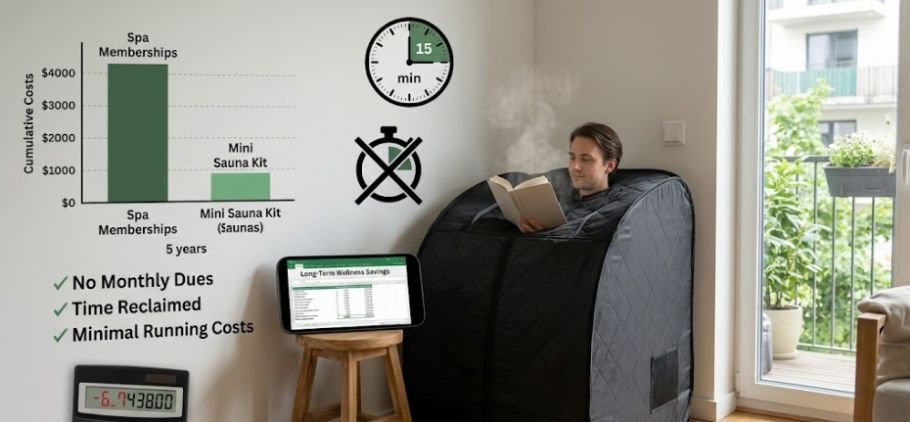
Stress isn’t going anywhere. And more people than ever have figured out that waiting until your back gives out or your sleep falls apart to do something about it is the expensive way to live. Prevention is cheaper. It’s also, frankly, a lot less miserable than the alternative. That’s part of why home wellness gear has exploded over the last few years — people are turning spare bedrooms and garage corners into little recovery zones instead of driving across town for one.
Heat therapy sits right in the middle of that shift. But before you drop money on a compact sauna, it’s worth doing real math — not just eyeballing the sticker price, but figuring out what the modular mini sauna actually costs you (and saves you) over five or ten years. That’s the point of this breakdown.
What Commercial Wellness Actually Costs You

Spa memberships look reasonable on paper. $120 a month, maybe $150 if you’re at a nicer club. Then you actually add it up over three years and the number gets uncomfortable fast.
And that’s before the stuff nobody mentions in the brochure. Gas. Parking — $8 here, $12 there if you’re in a city. A juice or a smoothie on the way out because, hey, you’re already there. I’ve talked to people who tracked this stuff for a month and were genuinely shocked. None of it’s dramatic on its own.
All of it adds up. The same cost-conscious approach can extend to daily nutrition, where choosing simple foods that help digestion may support digestive comfort without relying on expensive wellness products or specialty treatments.
There’s also the friction problem. Driving twenty minutes to sit in a room for twenty minutes just… doesn’t happen consistently. Life gets in the way. Memberships get paid for and quietly ignored. That’s not a moral failing, it’s just how humans behave when a habit requires effort to access.
Upfront Cost vs. What You Actually Pay Over Time
A compact home sauna is a one-time purchase. That’s the whole pitch, really. No monthly bill chasing you down.
Compare that to a full custom-built cedar sauna — the kind that needs a dedicated 240V circuit, actual plumbing work in some setups, and a contractor who knows what they’re doing. That’s a real construction project, easily five figures once labor’s involved. Mini units skip almost all of that. Plug it into a standard outlet, done.
Running costs are where it gets genuinely boring, in the best way. Basic wipe-downs. Maybe replace a liner or a panel every couple years. That’s about it. No club dues chipping away at your bank account every single month for the rest of your life.
The Health Math Nobody Talks About Enough

Regular heat exposure does real things to your body — better circulation, faster muscle recovery, lower inflammation markers, calmer nervous system. This isn’t fringe wellness talk anymore; it’s in cardiovascular research now, and has been for a while.
Regular heat sessions can also complement everyday movement habits, especially since walking every day benefits your body by supporting circulation, mobility, cardiovascular fitness, and stress management.
Here’s the part that actually matters for your wallet: better sleep and lower baseline stress mean fewer trips to urgent care, fewer physical therapy sessions, less reliance on whatever you’re currently popping for tension headaches. Nobody puts a price tag on “didn’t get sick this winter,” but ask anyone who’s paid a $300 copay for something preventable and they’ll tell you it’s real money.
Time Is the Asset Nobody Puts on the Spreadsheet
A spa trip eats close to two hours once you count driving, parking, changing, and waiting for a free spot in the steam room. Two hours. For twenty minutes of actual benefit.
Do that math over a year and it’s brutal. Skip the commute entirely and you’re getting back something like 150 hours annually — just from cutting three hours a week of travel. That’s almost four full work weeks handed back to you. Spend it on your kids, your job, or honestly just more sleep. Doesn’t matter. It’s yours again.
Energy Use Is Lower Than People Assume
I hear this concern constantly: “doesn’t it spike your electric bill?” Not really, and here’s why.
- Small footprint, fast heat. Less air to warm means less power needed to get there.
- Short preheat window. You’re pulling real wattage for maybe 10-15 minutes, not an hour.
- Zero standby draw. Turn it off, it draws nothing. No phantom load quietly running up your bill.
Compare that to a full multi-person wood sauna heating a whole insulated room, and the difference in monthly kilowatt-hours is not subtle.
It’s Not a Trend Purchase — It Actually Sticks Around
Half the fitness gear people buy ends up as a coat rack within six months. Mini saunas mostly don’t follow that pattern, and I think it’s because the use case is dead simple: sit, sweat, done. No learning curve, no motivation required beyond “I’m tired and my shoulders hurt.”
Good units are built to fold down or roll into a closet, which means they survive apartment moves and downsizes without becoming dead weight in a garage somewhere. That portability is quietly one of the biggest reasons these things hold their value over the ownership period instead of getting sold off at a loss a year later.
Bottom Line
Add it up — no membership fees, minimal transit costs, and power bills that barely move — and a modular mini sauna starts looking less like a luxury purchase and more like a pretty rational financial call. Factor in the recovered time and the very real chance of dodging a few expensive health issues down the road, and honestly, the math tends to favor buying one sooner rather than later.



Leave a Reply